

Your TSH came back normal but you still feel exhausted and foggy? Here's what standard thyroid testing often misses, and why your symptoms still matter.

Your TSH came back normal but you still feel exhausted and foggy? Here's what standard thyroid testing often misses, and why your symptoms still matter.
Belly fat, energy crashes, sugar cravings after 40? Discover the subtle early signs of insulin resistance that perimenopause can trigger — and what to do next.
Eating well but still gaining weight? Chronic stress may be blocking fat loss. Discover the 4 hormonal reasons why — and how to flip the switch.
You're eating well. You're moving your body. You're doing everything you're supposed to do. Yet the weight won't budge. If that sounds familiar, I want you to know something important: it's not a willpower problem. It might be your thyroid.
I know this one personally. A few years into perimenopause, I noticed weight creeping on despite my best efforts. My energy was low, my mood was off, and I just didn't feel like myself. I put it all down to "the change" Honestly, that's what most women do. Thyroid issues run in my family history, so when I finally investigated my thyroid, everything clicked into place. Suddenly the symptoms that had seemed so random made complete sense.
Your thyroid is a small butterfly-shaped gland in your neck and it has an enormous job: It regulates your metabolism. Think of it like the thermostat in your home. When it's working well, everything runs at the right temperature. When it's sluggish (a condition called hypothyroidism), your metabolism slows down, and your body starts holding onto weight even when you're doing all the right things.
The tricky part? Even a mild thyroid issue - one that might be sitting just outside the "abnormal" range on a standard blood test - can have a very real impact on how you feel and how your body responds to food and exercise. Many women are told their results are "normal" and sent on their way, still feeling terrible and wondering what's wrong with them. Nothing is wrong with you. You just haven't had the full picture yet. This is why I’m so passionate about full panel Thyroid hormone testing . This allows us to get a complete picture.
Here's where it gets complicated. Thyroid symptoms and perimenopause symptoms look almost identical. Fatigue, weight gain, brain fog, mood changes, disrupted sleep, feeling cold - they're on both lists. And irregular periods, which most women understandably chalk up to perimenopause, can also be a sign of thyroid dysfunction. This is exactly why thyroid issues get missed so often in women in their 40s and 50s. We assume it's hormones. Sometimes it is. But sometimes, it's both.
What makes this even more layered is that perimenopause can directly affect thyroid function. Fluctuating oestrogen levels can increase a protein called thyroid-binding globulin, which means less thyroid hormone is actually available for your body to use, even when your levels look "normal" on paper.
And the relationship between progesterone and the thyroid is a true chicken-and-egg scenario: we need adequate thyroid hormone for the ovaries to produce progesterone, yet as progesterone declines, it hinders the production and functioning of the thyroid itself - each one making the other's job harder at exactly the wrong time. This hormonal interplay is why so many women in perimenopause develop thyroid issues during this life stage. This is why looking at both together, rather than in isolation, is so important.
Ask for a full thyroid panel. TSH alone doesn't tell the whole story. Ask your GP to also test Free T3, Free T4, and thyroid antibodies. This gives a much clearer picture of how your thyroid is actually functioning day to day. GPs do the best they can, if they do not believe a full panel is warranted, you can order these tests privately through a Naturopath (Ahem, like me - wink wink). A consultation would be required to process this request.
Look at the full picture. Thyroid dysfunction rarely exists in isolation. Nutrient deficiencies (especially iodine, selenium, zinc, and iron), chronic stress, and gut health all influence how well your thyroid works. Addressing these alongside any medical treatment can make a meaningful difference.
Don't dismiss "subclinical" results. If your results come back borderline, don't let them be brushed aside. Subclinical hypothyroidism is real, and its impact on weight, energy, and mood is real too. You deserve to be heard and you deserve a practitioner who will dig deeper with you.
Stubborn weight gain in perimenopause isn't something you just have to accept. It's a signal worth investigating, and your thyroid is one of the first places to look. When you understand what's actually driving the problem, you can finally start addressing it in a way that works.
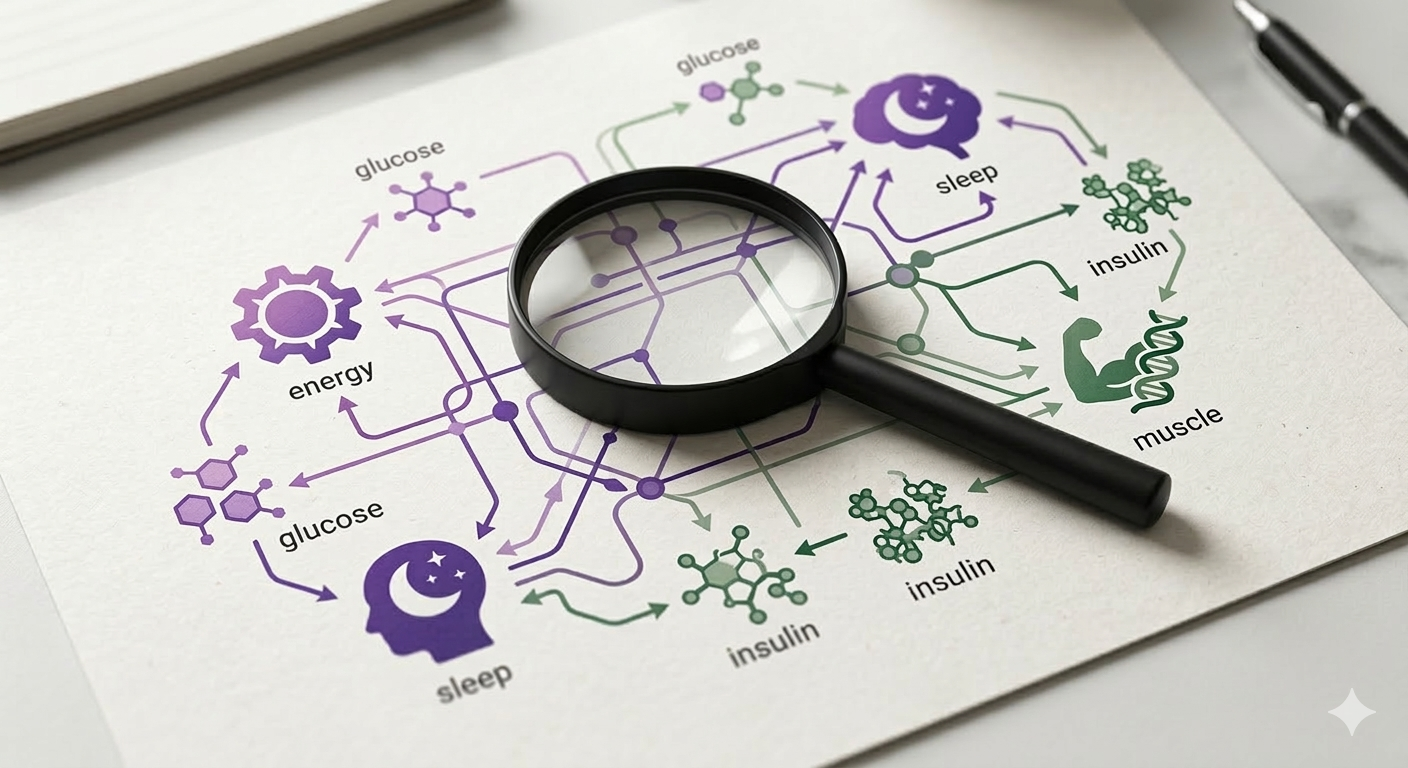
If you're not sure where to start, my free Metabolism Detective Quiz is designed to help you identify what might actually be driving your weight gain and whether it's your thyroid, your hormones, insulin resistance, or excess cortisol maybe contributing. Click the ‘Metabolism Detecive’ tab on the homescreen for your free download. Try it as a starting point to work out if your thyroid maybe contributing to how you’re currently feeling.
Part 2 of 3 in the Insulin Resistance Series
This has easily been one of the most common conversations I've been having in clinic lately.
Women are doing all the right things - they are eating well, staying active, trying to look after themselves -and yet almost like clockwork, they hit a wall around 3pm.
Energy drops. Focus disappears. Cravings kick in. And suddenly that second coffee or something sweet feels non-negotiable.
It's easy to brush this off as a busy day or poor sleep the night before.
But more often than not, this mid-afternoon slump can be a sign your blood sugar isn't as stable as it could be. Though it's rarely the only thing going on….
If you look at the infographic above, you'll see exactly what I mean.
On the left, a high-carbohydrate meal causes a rapid spike in blood sugar, followed by a sharp drop. This is the kind of crash many women feel mid-afternoon.
On the right, a more balanced meal (with protein, fats and carbohydrates) leads to a slower, more stable rise in blood sugar, resulting in sustained energy.
For some women, a 3pm crash can reflect exactly this pattern playing out earlier in the day, particularly after a high-refined-carb lunch. It's worth knowing that blood sugar is just one piece of the puzzle, alongside sleep, stress, meal size, and your natural circadian rhythm.
Every time you eat, your blood sugar rises.
In response, your body releases insulin to move that glucose out of your bloodstream and into your cells for energy.
When this system is working well, your energy stays steady.
But if your blood sugar rises too quickly, even from foods that seem "healthy", insulin can overcorrect, causing blood sugar to drop too low. This is sometimes called reactive hypoglycaemia, and it can happen within a few hours of eating.
That drop is what you feel as:
Fatigue
Brain fog
Irritability
Sugar cravings
Your body is simply trying to bring your energy back up as quickly as possible.
(And yes - the normal circadian dip that happens in the early afternoon can amplify all of this, which is why 3pm tends to be the magic hour for so many women.)
This is where hormones start to play a bigger role.
During the menopausal transition, changes in estrogen may influence glucose regulation and insulin sensitivity. However the relationship varies from person to person and is still an active area of research. What we do know is that many women notice a shift in their energy, cravings and metabolism during this time, and blood sugar regulation is often part of that picture.
Now lets add on top of that:
Cortisol (your stress hormone): Stress hormones like cortisol can raise glucose and alter how insulin works, especially around meals, meaning higher stress levels can make blood sugar swings more likely.
Muscle mass: Skeletal muscle plays a major role in glucose disposal. Resistance training is one of the most well-supported strategies for improving insulin sensitivity as we age, and it's something I'm a huge fan of for women in perimenopause.
This is why what worked in your 30s suddenly doesn't feel like it's working anymore. Your body hasn't failed you - it's just working differently, and it needs a different kind of support.
If this is happening regularly, you may notice patterns like:
Needing coffee or sugar to get through the afternoon
Feeling shaky, irritable or foggy
Grazing or snacking constantly after lunch
Feeling "wired but tired" later in the day
Getting a second wind at night
These aren't random symptoms — they're signals worth paying attention to.
And since it's Easter this week… let's be honest, there's probably more chocolate around than usual.
This isn't about avoiding it (because that's not realistic, or enjoyable).
But it is about how you eat it.
Chocolate, like any higher-sugar food, tends to affect your blood sugar more when eaten on an empty stomach or grazed on all day. The overall composition and timing of what you're eating matters more than any single food.
A few simple tweaks can make a real difference:
Have chocolate after a meal, not on its own
Pair it with protein or fat
Avoid the "all day picking" pattern
Sit down and enjoy it, rather than eating on the run
Your metabolism can absolutely handle chocolate… it just prefers not to be ambushed by it all day (GRIN)
The goal isn't perfection — it's stability.
Simple strategies that support blood sugar balance include:
Starting your day with protein : This sets your blood sugar up for the whole day. Aim for 30gms as a starting point
Building balanced meals : Protein + healthy fats + quality carbohydrates that have fibre in them - i.e plenty of vegetables!
Being mindful of long gaps between meals : Though this is individual; some women do well with fewer, larger meals, while others feel better eating more regularly
Incorporating resistance training : Genuinely one of the most powerful tools for glucose regulation
Being mindful with caffeine : especially on an empty stomach, which can amplify cortisol and affect blood sugar
Small, consistent changes here can have a significant impact on your energy, your mood, and how you feel in the second half of the day.
If you're experiencing regular energy crashes, cravings or stubborn weight gain, these patterns are often connected, and they're worth investigating properly.
In my previous post, I talked about the early signs of insulin resistance and how they often go unnoticed. And in the next post, I'll be breaking down how blood sugar, cortisol and fat storage all connect, particularly when it comes to belly fat after 40.
In Part 3, we're going deeper into something I hear about constantly in clinic: why belly fat seems to appear (or stick around) after 40, no matter what you do. I'll be breaking down the connection between blood sugar, cortisol and fat storage, and why the usual advice of "eat less, move more" so often misses the mark for women in this stage of life.
If you're reading this and recognising yourself in these patterns, a great place to start is figuring out what's actually going on under the surface. Head to the Metabolism Detective Quiz on my website. It takes just a few minutes and helps you pinpoint whether blood sugar, hormones, stress or something else might be at the root of how you're feeling.
Here’s the link: https://www.lisascarfonaturopath.com/metabolism-detective
If you feel like your body changed in your late 30s or 40s, you're not imagining it.
You're eating fairly well. You're trying to exercise. You're doing all the "right" things.
And yet:
the weight is settling around your middle
your energy is flat
you wake at 2–3am
and nothing works like it used to
This is the point many women start blaming themselves.
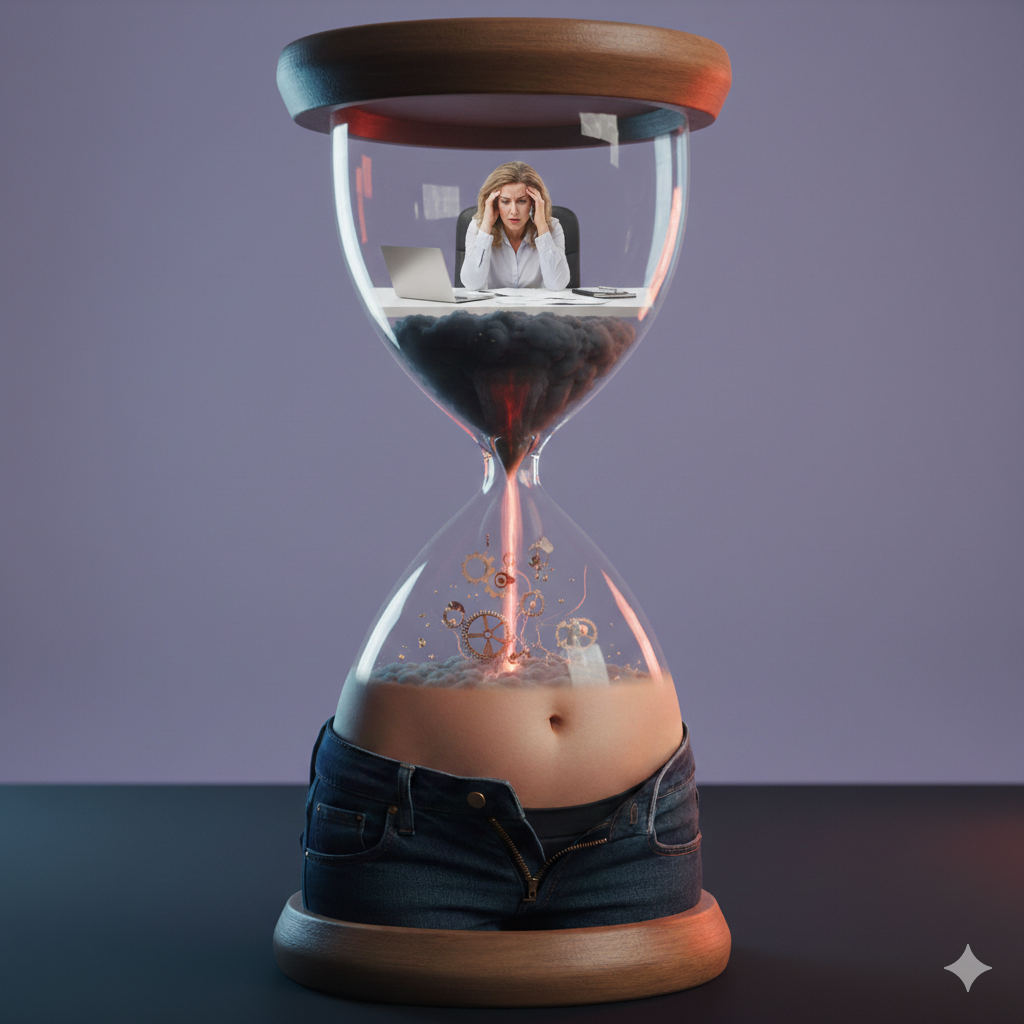
But in clinic, I see a different pattern: midlife belly fat is rarely about willpower — it's about a metabolism under stress.
The connection between burnout and belly fat is one of the most overlooked drivers of weight gain after 35. Once you understand it, things start to make sense.
One of the most common things I hear is:
"I'm not eating differently… so why am I gaining weight now?"
Midlife metabolism is influenced by several overlapping shifts:
Hormone changes
Perimenopause can begin years before menopause. Fluctuating oestrogen and progesterone are linked to more abdominal fat, more sleep disturbance, reduced insulin sensitivity and higher inflammation in many women.
Rising cortisol
Ongoing stress, poor sleep and busy schedules keep cortisol elevated. Higher cortisol is strongly associated with abdominal fat storage and visceral adiposity.
Blood sugar changes
Insulin resistance often creeps in during the late 30s and 40s, especially in women who have dieted for years or live in a constant stress response.
Thyroid sensitivity
The thyroid is very responsive to stress, under-eating and poor sleep. Even with "normal" blood tests, metabolism can feel slower.
Muscle changes
From our mid-30s onward, muscle mass gradually declines if we don't actively support it. Less muscle = lower metabolic output.
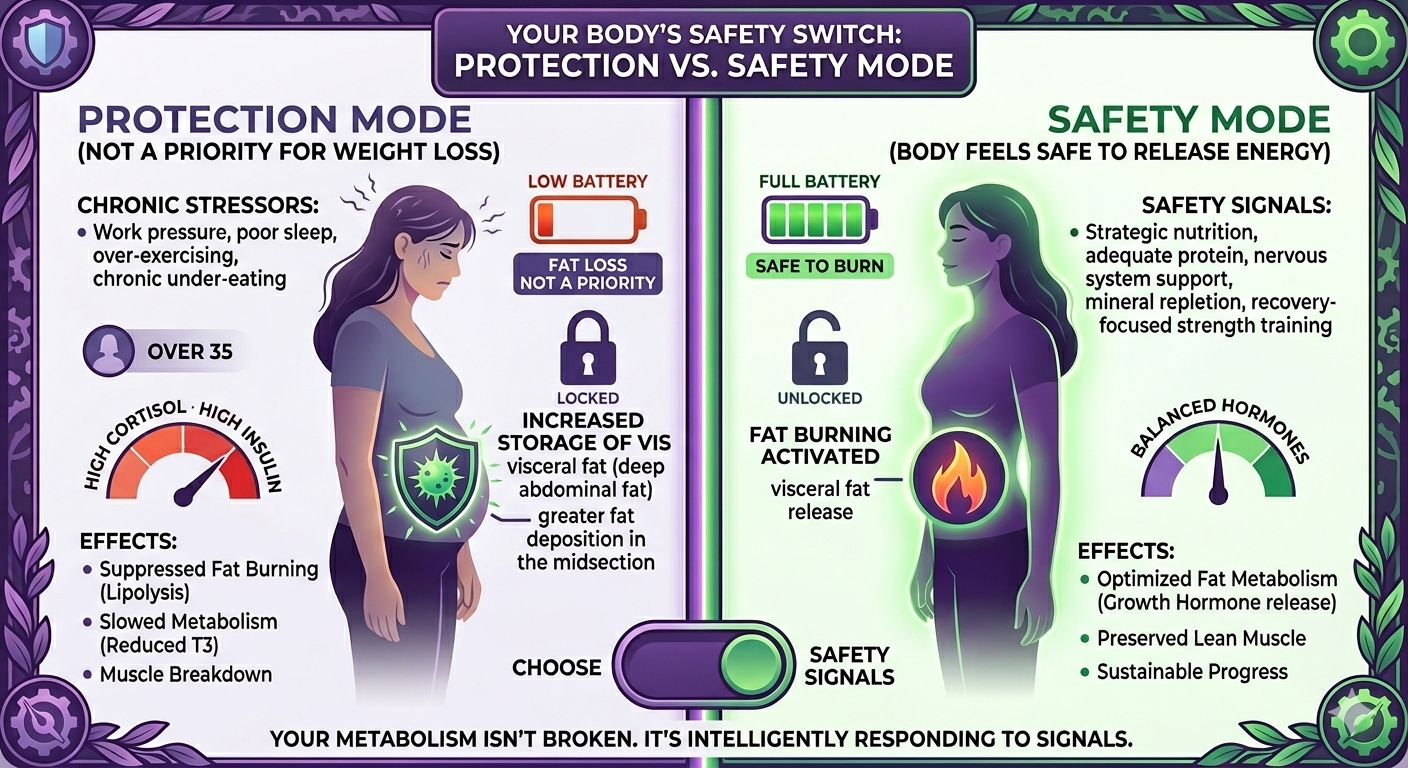
The key takeaway: Your body hasn't suddenly become lazy. It has become protective.
We often think of burnout as emotional exhaustion. But physiologically, burnout shows up as a state where your stress system and metabolism are stuck in survival mode, often leading to more hunger, more central fat storage and subtle reductions in energy expenditure over time.
When the body perceives ongoing stress, it adapts by:
conserving energy
storing fat
increasing hunger
lowering metabolic rate
This is not a flaw. It's a survival response.
Women juggling work, family, aging parents and poor sleep are often running on stress hormones for years. Over time, this creates the perfect environment for stubborn belly fat.
Here's how the cycle typically unfolds:
Stress increases cortisol
Cortisol raises blood sugar
Insulin rises
Fat is stored (especially around the middle)
Sleep becomes disrupted
Cravings increase
Cortisol rises again
Cortisol doesn't create fat out of thin air, but it can nudge you toward eating more and storing more of what you eat around your middle.
Signs this may be happening for you:
Belly fat that won't budge
Afternoon energy crashes
Sugar cravings
Feeling wired but tired
Waking overnight
Brain fog
Feeling puffy or inflamed
If you recognise yourself here, it's not because you've lost discipline. It's because your metabolism is trying to protect you.
Many women respond to midlife weight gain by eating less and exercising more.
In your 20s this may have worked. In your 40s, it often does the opposite.
Chronic dieting is associated with reduced active thyroid hormone (T3), lower resting metabolic rate, and a tendency to regain fat (often centrally) once restriction ends. This is the body's adaptive response to prolonged restriction.
When stress and restriction combine, the metabolism shifts further into survival mode — making weight loss harder, not easier.
You may be experiencing metabolic burnout if you notice several of these:
Weight gain around the middle
Persistent fatigue
Waking overnight
Brain fog
Feeling overwhelmed
Sugar cravings
Feeling cold easily
Irregular cycles
Low motivation to exercise
Blood tests "normal" but you feel off
Many women are told everything looks fine on paper — yet they don't feel fine at all.
These symptoms overlap with conditions like thyroid disease, anaemia and depression, so it's important to rule those out with your GP or specialist.
The solution isn't harsher dieting or more intense workouts. It's restoring metabolic safety.
When the body feels supported again, it becomes more willing to:
release stored fat
improve energy
balance hormones
restore sleep
Key areas to focus on:
stabilising blood sugar with balanced meals
rebuilding protein intake
supporting the nervous system
improving sleep
supporting thyroid and hormone health
choosing exercise that supports, not stresses, the body
Once your stress system, sleep and nutrition are more stable, moderate calorie deficits and the right type of movement tend to work better again.
You don't need more restriction. You need a strategy that works with your metabolism.
Not all midlife weight gain has the same driver.
In clinic, I commonly see different metabolic patterns:
stress-dominant
insulin-dominant
thyroid-dominant
hormone-dominant
These aren't official diagnoses, but helpful patterns I see clinically that guide where we start.
This is why generic plans often fail. If the root driver isn't addressed, the body continues to resist change.
If you're:
gaining weight around your middle
feeling exhausted
doing everything "right"
and nothing is working
Your metabolism may be stuck in survival mode.
Take the free Metabolism Detective Quiz to discover your dominant metabolic driver and where to start. (See separate tab at the top of my Homepage)
Midlife is not the beginning of decline. It's a transition that requires a different approach.
When you stop fighting your body and start supporting it, things can shift:
energy improves
sleep settles
weight becomes easier to manage
and you feel like yourself again
Your metabolism isn't broken. It's communicating.
The Belly Fat Puzzle — Solved
🔑 Belly fat after 35 is rarely about eating too much. It's about cortisol, insulin, and metabolic burnout working against you.
🔑 Cortisol stores fat around your middle and slows your metabolism.
🔑 Insulin blocks fat burning — especially when combined with high cortisol.
🔑 Dieting harder often makes it worse, not better.
Ready to understand YOUR metabolic pattern? Book your free Health Clarity Call with Lisa today.
You're not imagining it.
If you're eating less, moving more, and the scale is still creeping up — especially around your middle — I want you to know: this isn't in your head, and it's definitely not a lack of willpower.
For so many women in their late 30s, 40s, and early 50s, the same strategies that worked for years suddenly stop delivering. You're counting calories, skipping meals, pushing through workouts... and you're exhausted, frustrated, and stuck.
This isn't about what you're doing wrong. It's about your body changing — and needing a different approach now.
Calories don't tell the whole story. They don't tell us how your hormones are functioning, whether your blood sugar is stable, if your stress response is running on overdrive, or how much muscle you're carrying.
In perimenopause, your hormones, muscle mass, sleep, and stress levels dramatically change how many calories you burn, how hungry you feel, and whether those calories get burned or stored as fat.
1. Estrogen changes fat storage
As estrogen fluctuates and drops, your body becomes more insulin resistant and starts storing fat around your middle — even if you haven't changed how much you're eating. This is especially true when combined with poor sleep, stress, or refined carbs.
2. Eating less can backfire
When you chronically under-eat, your body interprets it as stress. It responds by cranking up hunger, making blood sugar erratic, breaking down muscle, and lowering your metabolic rate.
Sound familiar? Waking at 2am with racing thoughts. Afternoon energy crashes. Intense evening cravings. Stubborn belly fat that won't budge. These aren't signs you're failing — they're signs your body feels under threat.
3. Muscle loss tanks your metabolism
From your mid-30s onward, you naturally lose muscle unless you actively preserve it. In perimenopause, this accelerates. When you cut calories without enough protein and strength training, you lose muscle along with fat — and end up eating less while burning less at the same time.
4. Blood sugar chaos drives cravings and fat storage
Hormonal changes make blood sugar control more fragile. Unstable blood sugar means feeling "hangry," energy crashes, intense carb cravings, and more fat storage around your midsection. Calorie counting doesn't address this — and it's often the missing piece.
Sustainable weight loss in perimenopause requires a hormone-aware approach, not endless restriction:
Eat enough protein — Aim for protein at each meal (around 1.0-1.2g per kg of body weight daily for most women) to preserve muscle.
Balance your meals — Combine protein, fiber, healthy fats, and lower-glycemic carbs to stabilize blood sugar. Avoid under-eating all day then overeating at night.
Support your stress response — Prioritize sleep and nervous system regulation. Keep training realistic. When your body doesn't feel threatened, it's far more willing to release stored fat.
Get the right tests — If you have extreme fatigue, hair changes, irregular cycles, or significant belly weight gain, check your thyroid and metabolic health.
Create safety for your nervous system — Consistent meals, adequate fuel, and recovery tell your body it's safe to let go of stored energy.
When these systems are supported, a moderate calorie deficit becomes far more effective — and weight loss can happen without extreme restriction.
If "eat less and exercise more" has stopped working, you're not failing. Your body has changed, and it needs a different strategy.
Weight loss after 35 isn't about eating less and less. It's about working with your physiology — your hormones, muscle, metabolism, stress, and blood sugar — so a gentle energy deficit actually delivers results.
You deserve an approach that honors what your body is going through, not one that fights against it.
Want to know exactly what's blocking your weight loss? I've created a free Metabolism Detective Quiz to help you uncover what's really happening with your metabolism, hormones, and stress response. Head to the home page of my website and look for the ‘Metabolism Detective” tab to download your free quiz. In just a few minutes, you'll get personalized insights into which metabolic pattern you're stuck in — and the exact steps you need to take to finally start seeing results again.
If eating less actually worked, you wouldn't still be here.
You wouldn't be tracking calories, skipping meals, choosing the "good" option, or wondering why weight feels harder to shift now than it ever did before.
Yet for many women in their late 30s, 40s and 50s, the pattern looks like this: you're eating less than you used to, often less than your partner, you're trying to be disciplined — and your body responds by holding on tighter.
I know how isolating this feels. You're doing everything the internet tells you to do, everything that worked in your 20s, and your body seems to be working against you. You might even feel like you're failing at something that should be simple.
This isn't a willpower problem. It's a physiology + context problem.
And once you understand what's really happening inside your body, the struggle starts to make sense.
The basic principle of energy balance still applies at any age: fat loss ultimately requires a sustained negative energy balance.
What changes after 35 is how the body responds to dieting.
Much of the traditional advice around weight loss:
didn't account for perimenopausal hormonal shifts
didn't consider chronic stress and sleep disruption
and often ignored age-related loss of lean muscle
In midlife, these factors interact in ways that make aggressive restriction harder to tolerate and less effective over time.
And here's what makes this so frustrating: the advice you're following isn't wrong for everyone — it's just incomplete for where you are now. Your body has different needs than it did a decade ago, and no one warned you about that shift.
Consistently eating too little for your body's needs is recognised as a form of low energy availability.
The body responds by shifting into an energy-conserving state:
slowing processes that aren't essential for immediate survival
prioritising blood sugar stability over fat loss
This isn't dysfunction — it's adaptation.
Prolonged calorie restriction — particularly when combined with low carbohydrate intake — is associated with:
lower circulating T3
reduced conversion of T4 to active T3
lower resting energy expenditure
This pattern has been described in studies of low energy availability and chronic dieting.
Importantly, this can occur even when basic thyroid screening appears "normal", especially if only TSH and T4 are measured and T3 is not assessed, or if values sit within wide reference ranges.
If you've been told your thyroid is "fine" but you still feel exhausted and cold all the time, this might be why. It's incredibly invalidating to feel terrible while being told everything looks normal on paper. This is where I would normally suggest we get a blood test with a full Thyroid panel done so we can learn exactly what’s going on regarding TSH, T4, T3, thyroid antibodies and Reverse T3. Only then can we have a true understanding of your current thyroid health.
Common experiences associated with this possible underactive thyroid state include:
feeling colder than usual
low energy
reduced exercise tolerance
In energy deficit, counter-regulatory hormones such as cortisol help maintain blood glucose.
When restriction, stress and poor sleep persist together, cortisol exposure over time is associated with:
increased central (abdominal) fat storage
muscle breakdown
disrupted sleep
increased cravings
Not every woman will experience all of these — but this pattern is well-described in chronically stressed, under-fuelled states.
To be clear: in controlled conditions, sustained calorie deficits reduce total and abdominal fat.
The problem arises when very low or prolonged dieting is layered onto:
perimenopausal hormonal change
chronic stress
sleep disruption
and age-related muscle loss
In this context, aggressive restriction:
increases metabolic adaptation
reduces resting energy expenditure
and raises the likelihood of weight regain — often preferentially around the abdomen — when normal eating resumes
This is the cruel irony that so many of my clients describe: the harder they try, the worse it seems to get. You're not imagining it, and you're not doing it wrong. The approach itself needs adjusting.
This is why many women report "doing everything right" yet cycling between loss and regain, particularly around the middle.
Metabolic adaptation (also called adaptive thermogenesis) is well-documented.
After sustained dieting, the body may:
burn fewer calories at rest than predicted
reduce spontaneous movement
become more energy-efficient
This occurs at all ages, but its impact is greater in midlife when:
lean mass is already declining
recovery capacity is lower
stress load is higher
Repeated dieting without adequate recovery often leads to diminishing returns.
These signs are not diagnostic and can overlap with other conditions (such as anaemia, thyroid disease or depression), but they can be compatible with low energy availability:
stalled or reversing weight loss
fatigue that doesn't improve with rest
hair thinning or brittle nails
low motivation or flat mood
exercise feeling harder over time
If you're reading this list and nodding along to most of them, I see you. These symptoms are real, they're disruptive to your life, and they deserve proper attention — not another round of "just try harder."
Clinically, these patterns warrant proper assessment rather than further restriction.
For women with a long history of dieting and high stress, restoring sufficient energy intake, sleep and recovery often needs to happen before another fat-loss attempt.
This allows some of the body's conservation responses to ease.
I know this can feel counterintuitive — even scary. After years of restricting, the idea of eating more can trigger real anxiety. But this isn't about giving up on your goals; it's about creating the foundation that actually allows them to happen.
I'm currently working with several women where undereating was actually contributing to their weight gain. Once I had them eating more regularly and more of the right foods, they began burning fat. For example, one client on my 3-month program is at the 7-week mark and has lost 6.6kg and 6cm off her waist — not by eating less, but by eating appropriately for her body's needs.
Adequate protein:
helps preserve muscle during weight loss
supports appetite regulation
increases post-meal energy expenditure via the thermic effect of food
While this thermic effect is modest, it contributes to overall metabolic health.
Very low-carbohydrate intake, particularly alongside low energy intake, has been associated with:
lower T3
higher cortisol responses
For some women, reintroducing appropriate carbohydrate (especially around training or in the evening) can:
improve sleep
reduce perceived stress
support thyroid hormone patterns
This doesn't mean "more is better" — it means context matters.
From a physics standpoint, fat loss still requires a calorie deficit.
The clinical reality is that in chronically under-fuelled, high-stress midlife women, repairing metabolic stress first often makes later, moderate restriction:
more effective
more sustainable
and far less miserable
In other words: addressing low energy availability, sleep and stress doesn't replace fat loss — it enables it.
If eating less was the answer, you wouldn't still be struggling.
Your body isn't lazy. Your metabolism isn't broken. And pushing harder isn't the solution.
You've been working so hard for so long. The exhaustion, the frustration, the feeling like you're fighting your own body — it all makes sense now. Understanding why your body is responding the way it is changes everything.
If you're eating well, trying hard, and still not seeing results, your metabolism is giving you information — it just needs to be interpreted correctly.
I've created a free Metabolism Detective Quiz to help identify which metabolic patterns may be at play for you, and what your body likely needs next.
👉 You can download the Metabolism Detective Quiz from its own tab on the homepage of my website.
Clarity is the first step toward working with your body instead of against it.
Every January, I see the same thing happen.
Big promises. Extreme rules. "All or nothing" plans.
And by the time February rolls around? Most New Year's resolutions have quietly disappeared.
Sound familiar? You start strong on January 1st, but by week three, you're exhausted, the rules feel impossible, and you're wondering why you can't just stick with it.
Here's what I want you to know: it's not because you're lazy. It's not because you "lack willpower."
It's because most resolutions are unrealistic, unsustainable, and disconnected from how the body actually works — especially if you're a woman over 35 navigating hormonal shifts, a slower metabolism, and energy that doesn't bounce back like it used to.
Maybe you've noticed the same diet that worked in your 20s isn't working anymore. Perhaps you're dealing with energy crashes by 3pm, weight that seems to cling on no matter what you try, or a body that feels like it's working against you instead of with you.
As a naturopath, I don't love New Year's resolutions — particularly when it comes to weight loss after 35 — because they often set people up to fail before they've even begun.
Let's talk about a better way.
Most resolutions sound something like this:
"I'm cutting sugar completely"
"I'm going to exercise every single day"
"I'll lose 10kg by March"
"No carbs, no treats, no slip-ups"
They're ambitious… but they're also short-term, rigid, and driven by pressure, not physiology.
When goals are:
Too extreme
Too many at once
Not aligned with real life
Your nervous system pushes back. Motivation fades. Fatigue sets in. And suddenly, the old habits creep back in — often with guilt attached.
This isn't a mindset failure. It's a strategy problem.
Here's what I see again and again in clinic:
The clients who achieve lasting weight loss and better energy aren't the ones who go hardest in January.
They're the ones who:
Make small, realistic changes
Focus on months, not weeks
Work with their hormones, metabolism, and lifestyle — not against them
Health isn't built in a 4-week sprint. It's built through consistent habits repeated over time.
Consistency beats intensity. Every time.
Sustainable weight loss isn't about eating less and pushing harder.
It's the by-product of supporting the body properly across multiple pillars of health — especially blood sugar balance, hormones, stress regulation, and metabolism.
Here are the foundations I encourage clients to focus on instead of rigid resolutions:
1. Eat Real Food (Most of the Time)
You don't need perfection.
Start with:
Reducing ultra-processed foods
Eating meals that actually nourish you
Prioritising whole, colourful foods
Ensuring at least half your plate is non-starchy vegetables
Think leafy greens, cruciferous vegetables like broccoli and cauliflower, and colourful options like capsicum, tomatoes, zucchini, cucumber, mushrooms, asparagus, and green beans. These foods provide fibre, micronutrients, and antioxidants that support digestion, blood sugar balance, liver function, and hormone metabolism — all essential for sustainable weight loss.
Progress over perfection.
2. Aim for Around 30g of Protein Per Meal
Protein is one of the most under-eaten nutrients in women, particularly over 35.
Adequate protein supports:
Blood sugar stability
Appetite regulation
Lean muscle maintenance
A healthier metabolic rate
This one habit alone, done consistently, can dramatically reduce cravings and energy crashes.
3. Stay Hydrated (Yes, It Matters)
Dehydration often masquerades as:
Fatigue
Hunger
Sugar cravings
Headaches
A practical place to start: begin with a small glass of water each hour and gradually build to a larger glass as your body adapts. This helps ensure proper hydration without feeling overwhelming.
Hydration plays a key role in metabolism, digestion, energy production, and appetite signalling.
4. Prioritise Sleep for Hormonal Balance
Poor sleep increases cortisol, disrupts blood sugar, and drives hunger hormones — making weight loss far more difficult.
You don't need perfect sleep. You just need better sleep, more often.
5. Move Your Body in a Sustainable Way
Exercise does not need to be extreme to be effective.
Sustainable movement might include:
Walking most days
Strength training 2–3 times per week
Choosing movement you can maintain long-term
Burnout is not a requirement for results.
6. Address Mindset (Because It's Not "Just Discipline")
Your thoughts influence your nervous system, hormones, and behaviours.
Shifting from:
"I've failed again"
to
"I'm learning what my body needs"
creates physiological safety — and that's when real change begins.
7. Build in Accountability
We are not meant to do this alone.
Support and accountability significantly improve long-term success, especially for women navigating stress, hormonal changes, and metabolic resistance.
This might look like:
Asking a friend or family member to support your long-term changes
Or seeking professional accountability with a health practitioner, such as a naturopath who specialises in this area — this is exactly the kind of support I provide in my practice
Having someone in your corner helps turn good intentions into consistent action.
Instead of asking:
"What can I achieve by February?"
Try asking:
"What habits could I realistically maintain over the next 6–12 months?"
When you focus on:
Nourishing your body
Regulating stress
Supporting hormones
Building realistic, repeatable habits
Weight loss becomes a natural outcome, not a constant battle.
I'll be honest with you: this approach takes patience. It won't deliver dramatic results in two weeks. But here's what it will do — it will actually work. And it will keep working, month after month, because you're building something sustainable instead of another short-term fix that leaves you starting over next January.
If you're tired of starting over every January and want a more personalised, physiology-based approach to weight loss and energy, there are two simple ways to get started:
Download my Metabolism Detective Quiz This free quiz helps identify which metabolic and hormonal factors may be holding your body back — and where to focus first.
Book a no-obligation Discovery Call If you'd prefer personalised support, you can book a free discovery call via the Book Online button on my website to explore whether working together is the right fit.
You don't need another resolution. You need a strategy that works with your body — long term.
For women over 35 who want to enjoy Christmas, feel amazing, and stay on track with their metabolism
December can feel like a metabolic minefield — long lunches, late nights, cocktails, desserts, stress, travel, and a calendar bursting with social events. For many women in their late 30s to 50s, this is also a time when perimenopause, thyroid changes, and cortisol fluctuations make weight gain feel frustratingly easy.
But here's the truth: Fat gain over the festive season is not inevitable. You simply need a strategy — not restriction.
Instead of dieting your way through December (hello, burnout), the key is learning how to support your metabolism, reduce big glucose spikes, and enjoy the season without feeling like you've "blown it."
Let's walk through the simple, science-backed framework I teach my clients to minimise fat gain during the festive season — while still eating the foods you love.
Hormones shift. Stress rises. Sleep gets patchy.
And when cortisol and insulin are elevated together, your physiology becomes more biased toward storing energy, particularly around the belly.
Perimenopause and busy-mum-life also mean you may be more sensitive to sugar and alcohol than you used to be.
Your goal this season isn't perfection — it's keeping insulin steady and cortisol calmer so your body doesn't default into fat-storage mode.
And the small tweaks below do exactly that.
Aim for 25–30g of protein within the first hour of waking.
Why? Because a protein heavy breakfast does this:
stabilises blood sugar
reduces cravings later in the day
may support a healthier cortisol pattern over the day
improves energy
prevents afternoon snacking
Examples:
Protein smoothie
Eggs + greens
Greek yogurt with seeds
Leftover roast chicken on veg
Protein early in the day sets the tone for metabolic stability — especially during a month filled with high-sugar foods.
This is one of the simplest and most powerful metabolic hacks you can use.
Research shows that eating protein before carbohydrates significantly reduces the glucose and insulin spike from the meal.
Why?
Because protein stimulates hormones like GLP-1, CCK, and PYY.
These hormones:
slow gastric emptying
tell your brain "I'm getting full"
reduce how much insulin your body needs
flatten the glucose spike from the carbs you eat next
often reduce cravings for sugar afterwards
Clinical trials have shown that eating protein (and vegetables) first can lower glucose by up to around 30–40% after the meal in some studies.
This is HUGE — especially for women over 35 whose insulin sensitivity naturally declines.
How to apply this at Christmas lunch:
Eat 3–5 bites of protein first
Then your vegetables
Then your healthy fats
Then your slow-release starch ("Anchor Carb")
Dessert last (if you still want it)
This tiny sequencing tweak can make a surprisingly big difference to how you feel after meals.
Instead of grazing on sweets or loading up on multiple "treat" foods, choose one slow-release starch to anchor your plate.
Examples:
Roasted potatoes
Sweet potato
Pumpkin
Quinoa salad
Basmati rice
Lentil or chickpea salads
Why this works:
Potatoes (especially cooled) have the highest satiety index of all foods. When prepared simply, and especially when cooled and combined with protein and fibre, they can provide sustained energy and satiety.
They help reduce the size and speed of glucose and insulin spikes, keeping you full and reducing dessert cravings.
This festive carb strategy is FAR better than simply "limiting treats" — because it keeps your hormones more stable.
This is the plate formula my clients swear by:
1. Protein first Starts satiety hormones + reduces insulin spike.
2. Fibre / vegetables Can lower glucose spike by 20–40% in some studies.
3. Healthy fats Slow digestion + improve satisfaction.
4. Slow-release starch ("Anchor Carb") Keeps you full, reduces sugar cravings.
5. Dessert LAST (if you still want it) By this point, your insulin and cravings are calmer — and portion size naturally drops.
One of the MOST research-backed strategies to flatten glucose is a short walk within 20 minutes of eating.
This:
improves glucose clearance
can reduce the degree to which meals drive fat storage over time, especially when done regularly
improves digestion
stabilises energy
reduces inflammation
If you do one thing this season, let it be this.
Even one poor night of sleep increases hunger hormones the next day. Add alcohol? It can further disrupt sleep and appetite signals the next day.
Quick tips to try:
magnesium before bed
10-minute wind-down
stopping alcohol 2–3 hours before bed
earlier nights where possible
Better sleep = fewer cravings + less fat storage.
Dehydration increases cravings and fatigue — and can aggravate histamine-related symptoms, which some women find worsen in perimenopause due to hormonal flux.
Before events:
Drink 500 ml water or electrolytes
Alternate alcohol with water
Herbal tea when home
Your liver will thank you.
If you do indulge heavily (and you will at some point!), here's your gentle reset:
Protein-rich breakfast
2–3L water
Light movement
Lower-histamine foods
Early night
No guilt
You're simply helping your hormones rebalance.
Fat gain over Christmas happens not because you're "bad" or "undisciplined" — but because the festive season is a perfect storm for blood sugar instability, cortisol spikes, poor sleep, and inconsistent eating patterns.
With the right framework, you can enjoy the season fully and feel amazing in your body.
If you've been struggling with weight gain, stubborn belly fat, or energy crashes despite "doing everything right," the answer might lie in your hormones — not your willpower.
Take the Metabolism Detective Quiz to find out whether cortisol, insulin, thyroid or oestrogen is behind your symptoms — and what to do next. To download, click on the Metabolism Detective Tab on the home page, fill in your details and it will be in your inbox in no time!
Understanding your metabolic roadblock is the first step to feeling like yourself again.